Webinar - Flow and Shear Stress in Organ-on-Chip: From Microfluidic Control to Vascularized Brain Organoids
Session
📅 Two live sessions available on December 1st 2026:
4:00 PM CEST – Register here
Understanding Flow and Shear Stress in Advanced In Vitro Models
In Organ-on-Chip and advanced 3D cell culture models, flow does more than transport nutrients and compounds. It also contributes to the mechanical environment experienced by cells, including fluid shear stress, an important parameter in vascular and endothelial models.
But how can biological requirements be translated into controlled microfluidic conditions?
In this webinar, discover the fundamentals linking flow rate, channel geometry, fluid properties and shear stress, and explore practical approaches for stable perfusion and recirculation in advanced cell culture models.
The session will combine these fundamental principles with a research case study on vascularized human brain organoids under microfluidic flow, presented by Dr. Eva Veiss from her doctoral research at CEA Paris-Saclay.
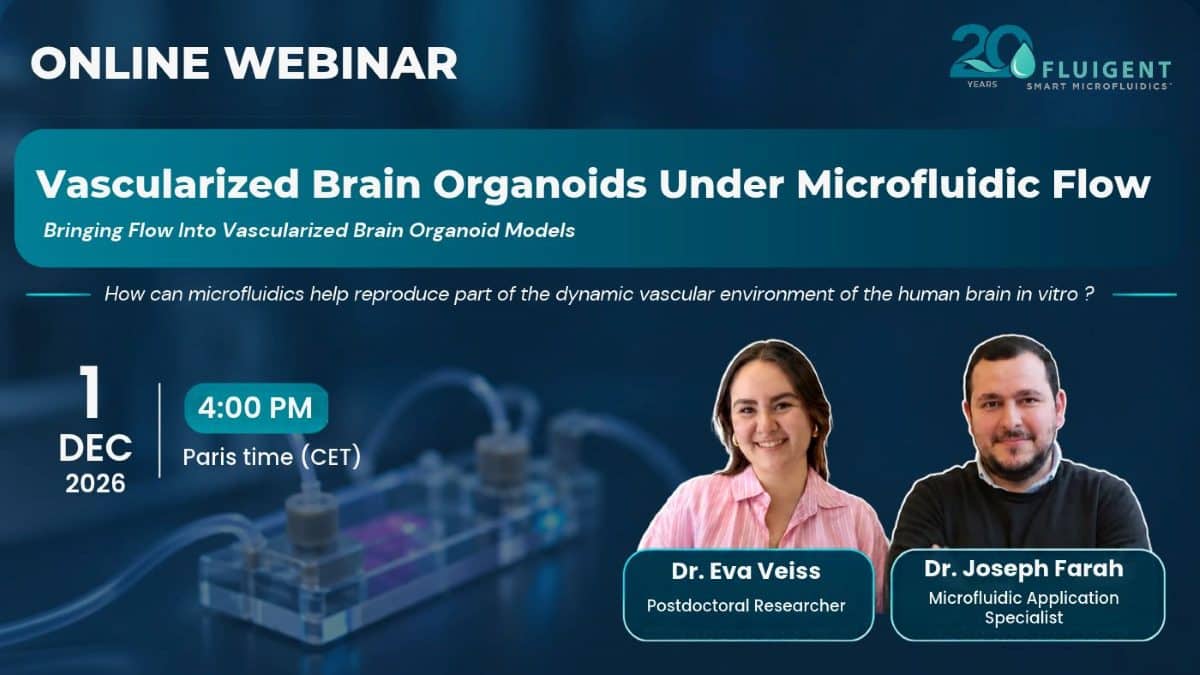
Speaker :
- Dr. Joseph Farah
Microfluidic Application Engineer – Fluigent - Dr. Eva Veiss
Postdoctoral Researcher, CEA Paris-Saclay
What Will You Learn?
- Understand why flow and shear stress are important experimental parameters in advanced in vitro models.
- Learn how biological requirements can be translated into controlled microfluidic conditions.
- Explore approaches for stable perfusion and media recirculation in long-term cell culture.
- See how microfluidics can be integrated with vascularized 3D organoid models.
- Discover how controlled flow can support neurovascular-unit and disease-modeling studies.
Flow and Shear Stress in Organ-on-Chip
With Dr. Joseph Farah
Microfluidic Application Specialist, Fluigent
In vascular models, fluid flow is not only a transport mechanism; it can also act as a mechanical cue. Endothelial cells respond to flow-induced shear stress through changes in morphology, alignment and mechanotransduction, with the response depending on the magnitude, direction and duration of the applied flow.
However, flow rate and shear stress are not interchangeable. The local shear stress experienced by cells depends on several parameters, including flow rate, channel geometry, fluid viscosity and the local velocity field.
- How flow rate, channel geometry and fluid viscosity determine shear-stress conditions.
- How to define relevant flow conditions for vascular and Organ-on-Chip experiments.
- How pressure-based flow control can support stable and reproducible perfusion.
- Practical considerations for continuous flow and recirculation in long-term culture.

Illustrative comparison of static and flow-exposed endothelial culture.
Case Study: Vascularized Human Brain Organoids Under Microfluidic Flow
With Dr. Eva Veiss
Postdoctoral Researcher, Institut Imagine
Research presented from her PhD work at CEA Paris-Saclay
The neurovascular unit (NVU) is a multicellular system whose coordinated function is essential for the central nervous system. Alterations of the NVU are involved in several neurodevelopmental and neurological disorders.
Reproducing this complex environment in vitro remains challenging, particularly when both 3D multicellular organization and dynamic vascular conditions need to be considered.
During her doctoral research, Dr. Eva Veiss contributed to the development and characterization of a vascularized human brain organoid model containing key cellular features associated with the neurovascular unit and blood-brain barrier.
The vascularized organoids were then integrated into a custom microfluidic device to introduce controlled flow and expose the developing vascular structures to flow-associated shear stress. A Fluigent Microfluidic Recirculation Pack was used to circulate culture medium and neurotrophic factors through the system under dynamic culture conditions.
- Development and characterization of vascularized human brain organoids.
- Integration of the organoids into a custom microfluidic perfusion system.
- Use of controlled flow and recirculation to expose developing vascular structures to shear stress.
- Perspectives for modeling neonatal hypoxic-ischemic encephalopathy.
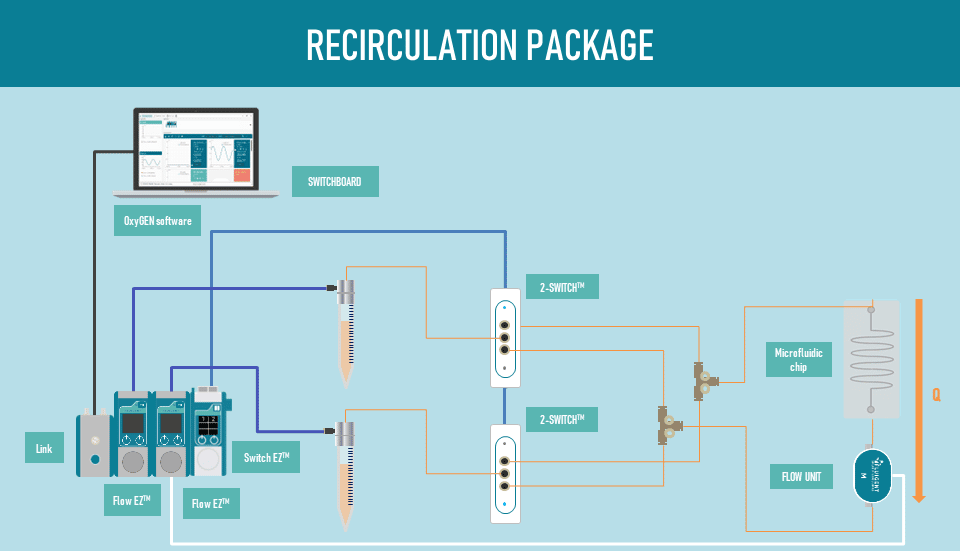
Microfluidic Pack for unidirectional and stable fluid recirculation
Join the Webinar
Whether you are working with Organ-on-Chip, vascular models, organoids or other perfused in vitro systems, this webinar will combine fundamental microfluidic principles with a concrete research application to explore how controlled flow and shear stress can be implemented in advanced cell culture models.
December 1, 2026 | 4:00 PM Paris time (CET)
From Controlled Flow to Automated Recirculation
Maintaining controlled flow over extended culture periods is an important consideration in Organ-on-Chip experiments. Depending on the application, researchers may need to control flow stability, recirculate limited volumes of culture medium, maintain a defined flow direction, or automate long-term perfusion.
Microfluidic Recirculation Pack
The Fluigent Microfluidic Recirculation Pack, used in the vascularized brain organoid study presented during this webinar, enables continuous circulation of culture medium through a microfluidic system using pressure-based flow control.
- Continuous media circulation.
- Stable microfluidic flow.
- Controlled recirculation volumes.
- Long-term perfusion of microfluidic cultures.

Omi™ — Automated Organ-on-Chip Platform
For researchers looking for a more integrated approach, Omi™ provides automated perfusion and recirculation for Organ-on-Chip workflows. It is designed to simplify long-term experiments by integrating fluid handling and flow control into a compact platform.
- Continuous perfusion and automated media recirculation.
- Controlled flow direction for long-term culture.
- Automated fluid-handling workflows for Organ-on-Chip experiments.
- Defined and reproducible flow conditions for advanced in vitro models.

👉 Ready to improve your setup? Get the best of our expertise.
Related Expertises
- Expert Reviews: Basics of Microfluidics
Organ-on-a-Chip vs Organoids: Differences, Strengths and When to Combine Them
Read moreOrgan on a chip vs organoid: compare architecture, perfusion, throughput and readouts, and see when combining both models works best.
- Expert Reviews: Basics of Microfluidics
The Role of Microfluidics in Advanced Organoid Modeling: from Static to Dynamic
Read moreIn this review, we explain why microfluidics is the best alternative to enhance organoid viability, promote tissue maturation, and support vascularization.
- Microfluidics Case Studies
A Microfluidic approach for modeling the blood-brain tumor barrier
Read moreDiscover how 3D-printed microvessels and pressure-driven flow recreate the blood-brain tumor barrier under physiological shear stress.
- Microfluidics White Papers
A review of Organ on Chip Technology – A White Paper
Read moreDiscover the concepts of OOC engineering and their applications in medical sciences.
- Microfluidic Application Notes
Peristaltic Pump vs Pressure-Based Microfluidic Flow Control for Organ on Chip applications
Read moreThe importance of flow stability in microfluidic systems is demonstrated by performing cell culture using peristaltic pumps or pressure-based flow controllers.