Microfluidics and Analytical Techniques: Benefits, Applications and Integration Strategies
Microfluidic analytical techniques are advancing modern analytical chemistry by enabling precise control of fluids at the microscale and integration of multi-step workflows within compact platforms. This review highlights their coupling with key analytical methods, including mass spectrometry, chromatography, electrophoresis, electrochemistry, and more. Selected examples demonstrate improvements in sample handling, analytical performance, and experimental efficiency across chemical and biological applications
Microfluidics in Analytical Chemistry and the Rise of Integrated Analytical Techniques
Microfluidics refers to the precise manipulation of fluids at the sub-millimeter scale, typically in channels of tens to hundreds of micrometers. At this scale, flow is dominated by laminar behavior and diffusion-driven transport, enabling highly controlled and efficient miniaturized systems for chemical and biological analysis.
The integration of fluid handling with analytical functions emerged with Micro Total Analysis Systems (μTAS), which proposed combining sampling, preparation, reaction, separation, and detection on a single device. This concept established the basis of microfluidics analytical techniques, where micro-scale flow control is directly coupled to analytical instruments (Figure 1). [1]

Microfluidics became a key technology in modern analytical chemistry, improving sensitivity, reproducibility, and throughput through precise control of nano- to picoliter volumes. Microfluidics analytical techniques are widely applied in mass spectrometry, chromatography, spectroscopy, electrochemical analysis and more.
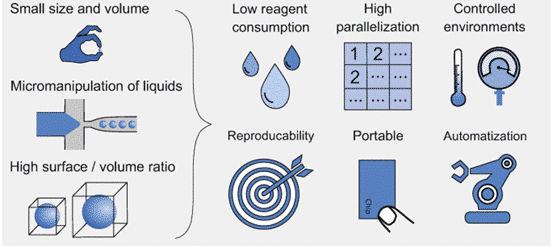
Its main advantages include reduced sample consumption, improved reaction efficiency, and better reproducibility due to integrated workflows and minimized contamination (Figure 2).
Today, microfluidics analytical techniques act as a bridge between classical analytical chemistry and automated laboratory systems, enabling real-time monitoring, single-cell analysis, and high-throughput screening with unprecedented precision. [2]
How to Integrate Microfluidics with Analytical Instruments
Integration of microfluidics with analytical instruments relies on a combination of microfluidic chips, fluid actuation systems, flow monitoring, and interfacing components that together ensure precise and reproducible operation in microfluidics analytical chemistry.
At the core of the system, microfluidic chips define the analytical workflow. These devices integrate channels, junctions, and functional structures such as mixers, reaction chambers, or separation units. Their geometry governs key parameters such as:
- Mixing efficiency,
- Residence time,
- And mass transport,
which directly influence analytical performance.
1. Why Fluid Handling Performance Matters in Analytical Microfluidics
In analytical microfluidics, the quality of fluid handling directly impacts experimental reproducibility and measurement accuracy. Even small fluctuations in flow rate can affect mixing efficiency, reaction kinetics, separation performance, and detector response.
Fluid handling is typically achieved using pressure controllers or syringe pumps, often combined with flow sensors for real-time monitoring. Pressure-driven systems are widely used due to their ability to deliver stable, pulse-free flow with high precision across a wide dynamic range. When coupled with flow sensors, these systems enable closed-loop control, ensuring accurate and reproducible delivery of nanoliter-to-microliter volumes.

Interfacing components then connect the microfluidic environment to external analytical instruments such as mass spectrometers, chromatographic systems, electrochemical detectors, or optical platforms (Figure 3). These interfaces are designed to minimize dead volume and ensure efficient, low-dispersion transfer of samples between systems.
Together, microfluidic chips, pumping and flow monitoring systems, and instrument interfaces form the foundation of modern microfluidics analytical techniques, enabling highly controlled, automated, and reproducible analytical workflows. [3]
2. Fluid Handling Technologies for Analytical Microfluidics
Comparison of Syringe Pumps and Pressure-Based Controllers for Microfluidic Analytical Systems
| Feature | Syringe Pump | Pressure-Based Controller |
|---|---|---|
| How it works | Pushes liquid with a moving syringe plunger | Pushes liquid by applying pressure to a reservoir |
| Flow stability | ⚠️ Can generate pulsations | ✅ Smooth, pulse-free flow |
| Response speed | 🐢 Slower adjustments | ⚡ Fast adjustments |
| Continuous operation | ❌ Limited by syringe volume | ✅ Continuous with reservoirs |
| Multiple channels | ⚠️ One pump per channel | ✅ Easy multi-channel control |
| Flow precision | ✅ Good | ✅✅ Very high (with flow sensors) |
| Automation | ⚠️ Moderate | ✅ Advanced automation |
| Best for | Simple experiments, low-cost setups | High-performance analytical workflows |
| Typical applications | Flow injection, reagent delivery | Spectroscopy, MS coupling, droplet microfluidics, high-throughput screening |
Fluigent has developed a range of pressure-based flow control solutions specifically designed for microfluidic applications. Among them, the Flow EZ™ pressure controller delivers fast response times and highly stable pressure regulation, enabling smooth and pulse-free flow generation across a wide range of operating conditions.
When combined with Fluigent flow sensors, Flow EZ™ can operate in a closed-loop configuration, providing real-time flow monitoring and automatic flow rate regulation. This approach ensures highly reproducible fluid delivery and helps researchers achieve reliable analytical results, even in applications involving nanoliter-scale flows or complex microfluidic networks.
These capabilities make pressure-driven flow control particularly valuable for analytical techniques such as spectroscopy, chromatography coupling, droplet generation, and high-throughput screening workflows.
Read this comparison review: Comparison between peristaltic, syringe and pressure pumps for microfluidic applications
Microfluidics for Sample Preparation and Pretreatment
Sample preparation is a key step in analytical workflows and strongly influences the performance of microfluidics analytical techniques. Microfluidic systems enable controlled dilution, mixing, filtration, extraction, and reagent handling in very small volumes. [4]
At the microscale, improved mass transfer and reduced diffusion distances lead to faster and more efficient processing compared to conventional methods. This enhances reaction kinetics and improves the handling of complex samples before analysis.
On-chip integration of preparation steps also reduces manual handling, limits contamination, and improves reproducibility. Furthermore, microfluidic platforms facilitate workflow automation by enabling precise and programmable control of fluid manipulation (Figure 4), thereby reducing operator intervention and increasing process reliability. As a result, these systems streamline upstream workflows prior to coupling with analytical instruments. [5]
From this perspective, the following sections will highlight key applications in mass spectrometry, chromatography, electrophoresis, electrochemistry, and spectroscopy.

1. Microfluidics and Mass Spectrometry
Mass spectrometry (MS) is one of the most analytical techniques coupled with microfluidics analytical techniques due to its high sensitivity and broad applicability. Microfluidic systems improve MS performance by enabling precise control of sample introduction, ionization, and reaction conditions at very low flow rates as displayed in Figure 5. [6,7]
A key integration approach is the use of nanoelectrospray ionization (nanoESI), where microfluidic channels deliver stable nanoliter flows directly to the ion source. This improves ionization efficiency while significantly reducing sample consumption. Droplet-based microfluidics further enables compartmentalized analysis, supporting high-throughput screening and single-cell studies. [6,7]

Microfluidic platforms also enhance online sample preparation prior to MS detection, including dilution, mixing, and chemical derivatization. This reduces manual handling, particularly in complex biological samples. [6,7]
Overall, coupling mass spectrometry with microfluidics analytical techniques enables:
- Higher sensitivity,
- Lower sample requirements,
- And improved temporal resolution for dynamic processes. [6,7]
2. How Does Microfluidics Enhance ICP-MS Analysis?
Inductively coupled plasma mass spectrometry (ICP-MS) is an elemental analysis technique used for ultra-trace detection of metals and isotopes (such as mercury as shown in Figure 6). It is widely applied in environmental monitoring, materials science, and bioanalysis due to its high sensitivity and wide dynamic range. [8]
Microfluidics analytical techniques improve ICP-MS workflows by enabling precise manipulation of very small sample volumes before introduction into the plasma source. Microfluidic channels allow controlled dilution, mixing, and conditioning steps, which help adapt complex samples to ICP-MS requirements while minimizing sample waste.

The use of microfluidic interfaces also improves transport efficiency from sample to ionization stage, particularly under low-flow conditions. This is especially beneficial for applications involving limited sample availability or continuous monitoring systems.
Typical applications include heavy metal detection in environmental water samples, trace element analysis in soil and industrial effluents, and elemental profiling in biological fluids. Microfluidic integration also supports water quality assessment and pollutant tracking with improved temporal resolution in flow-based analysis. [9,10]
3. Microfluidic Approaches for Chromatographic Analysis
Chromatography was among the first analytical techniques to be miniaturized, contributing to the emergence of lab-on-a-chip systems and the broader field of microfluidics. Early μTAS concepts envisioned integrating sample preparation, separation, and detection within a single microfabricated platform (Figure 7). [11]
Today, microfluidic devices are used to integrate chromatographic workflows and upstream processing steps within compact analytical systems. Their small footprint and high level of integration have facilitated the development of platforms for such chemical and biological analysis.
From microchip chromatography to multidimensional separation systems, microfluidics continues to expand the possibilities for miniaturized analytical chemistry. [12,13]

3. Microfluidics and Capillary Electrophoresis
Capillary electrophoresis (CE) is a separation technique that uses an electric field to separate charged molecules according to their electrophoretic mobility. Due to its high separation efficiency and natural compatibility with miniaturization, CE has played an important role in the development of microfluidics analytical techniques and lab-on-a-chip systems. [14]
Microfluidics extends the capabilities of CE by enabling integrated sampling, fluid handling, and detection within compact analytical platforms.
As an example, researchers from the Institut Galien Paris-Saclay (CNRS, Université Paris-Saclay), developed a modular microfluidic capillary electrophoresis platform coupled with LED-induced fluorescence detection using off-the-shelf components (Figure 8). The system incorporated pressure- and vacuum-driven flow control to enable automated continuous sampling and stable microflow conditions. Using this setup, the authors successfully separated fluorescent sulfobetaine-functionalized magnetic nanoparticles and monitored their interaction with dopamine in real time. This work demonstrates how microfluidics analytical techniques can transform conventional capillary electrophoresis into a flexible platform for nanoparticle characterization (Figure 9), drug delivery studies, and diagnostic applications. [15]


4. How Is Microfluidics Used in Electrochemical Analysis?
Electrochemical techniques are used in analytical chemistry for real-time chemical sensing and reaction monitoring. Their direct signal readout makes them well suited for integration with microfluidic systems, where reactions can be performed and analyzed within the same platform. [16]
Microfluidic electrochemical platforms typically integrate electrodes directly within microchannels, enabling measurements to be performed under continuous flow conditions. This configuration supports controlled reaction environments and allows electrochemical signals to be recorded in situ during fluid transport. [17]

As an example, researchers at Imperial College London developed an automated microfluidic electrochemistry platform to study cyclohexanol electrooxidation (Figure 10). The system enabled automated electrolyte preparation, controlled reaction conditions, and real-time measurements, allowing mechanistic insight and rapid screening of additives. This work highlights how microfluidics analytical techniques support electrosynthesis research and reaction analysis. [18]
5. Microfluidic Electrical Impedance Spectroscopy for Label-Free Analysis
Another label-free analytical technique commonly coupled with microfluidic systems is electrical impedance spectroscopy (EIS), which provides frequency-based electrical characterization of flowing samples.
EIS measures the frequency-dependent electrical response of a system, providing information on particle, cell, or droplet properties without the need for labeling.
In microfluidic systems, EIS is implemented through electrodes integrated into microchannels, where passing objects modulate the local electric field as they flow through the sensing region (Figure 11). The resulting impedance signal reflects differences in size, composition, and dielectric properties (Figure 12).
A typical electrical impedance spectroscopy platform combines microfluidic flow control, a sensing chip with embedded electrodes, and a lock-in amplifier for frequency-resolved signal detection. This configuration enables the analysis of individual objects in flow based on their electrical signature.
Unlike DC electrochemical measurements, impedance spectroscopy provides multi-frequency information, making it particularly suitable for distinguishing heterogeneous populations in flowing samples. [19,20]


6. Microfluidics and Spectroscopy
Spectroscopic techniques such as UV-Vis, fluorescence, and Raman spectroscopy are widely used for label-free molecular and biochemical analysis. However, their performance can be limited when applied to complex samples due to weak signal intensity, optical scattering, and inefficient interaction between light and analyte in bulk solutions.
Microfluidics addresses these limitations by confining the sample into well-defined microchannels, where optical interrogation can be better controlled. The small dimensions reduce optical path variability and enable precise alignment between the excitation beam and the sample volume. In addition, controlled flow conditions allow continuous renewal of the analyte in the detection zone, improving measurement stability over time. [21,22]
As an example, F. Zorzi et al. from the Istituto Italiano di Tecnologia and Politecnico di Milano developed a microfluidic lab-on-a-chip platform enabling 3D hydrodynamic focusing for Raman spectroscopy (Figure 13). This approach confines the sample within the optical interrogation region, enabling full-volume, low-noise measurements of non-transparent fluids such as whole blood. It improves signal quality and enables faster acquisition with reduced photodamage compared to bulk measurements. [23]
This work demonstrates how coupling spectroscopy with microfluidic analytical techniques enables more efficient analysis of complex biological samples, while supporting real-time and effiecient optical diagnostics.

7. Droplet-Based Microfluidics Coupled with FACS Sorting
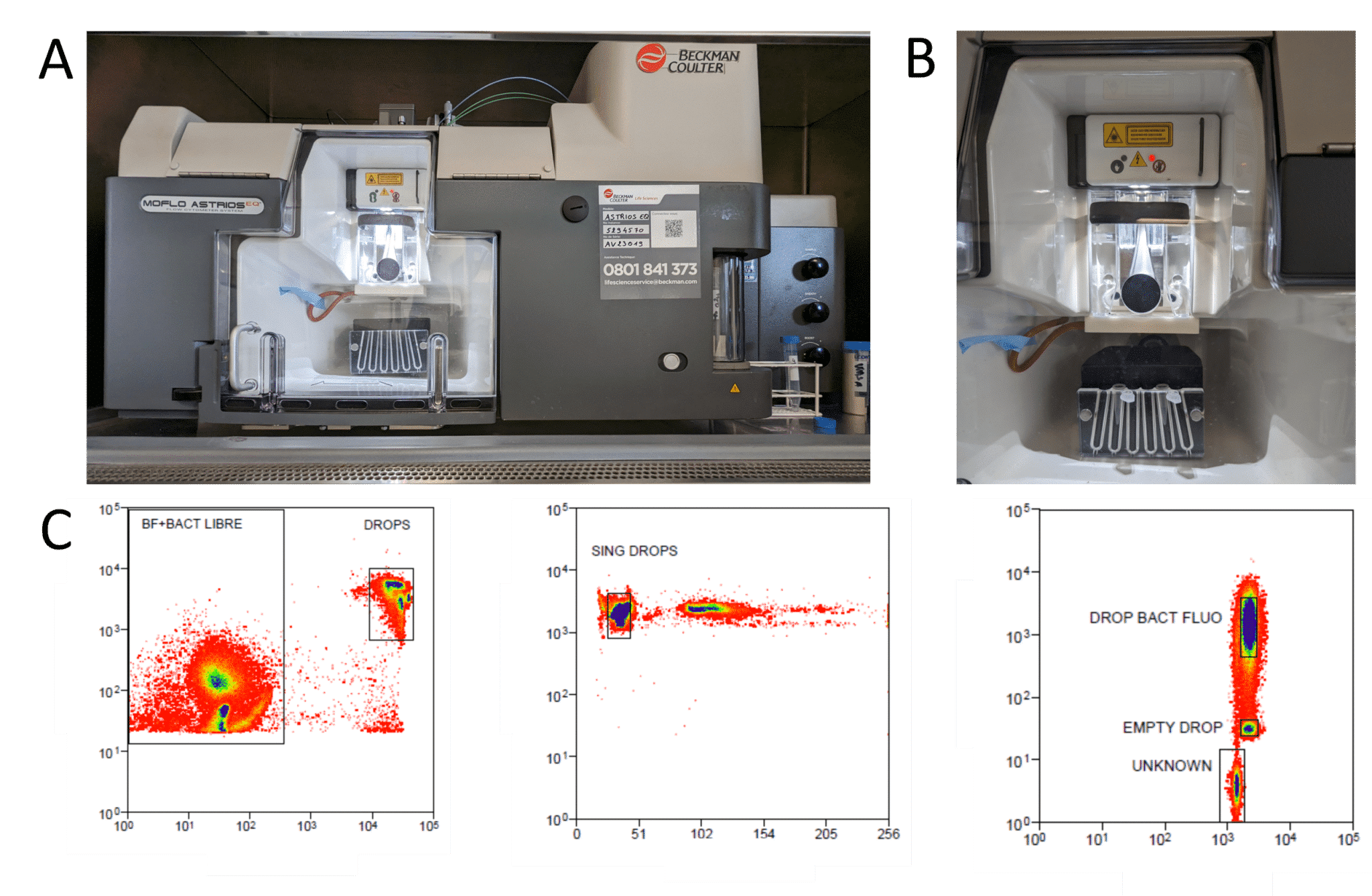
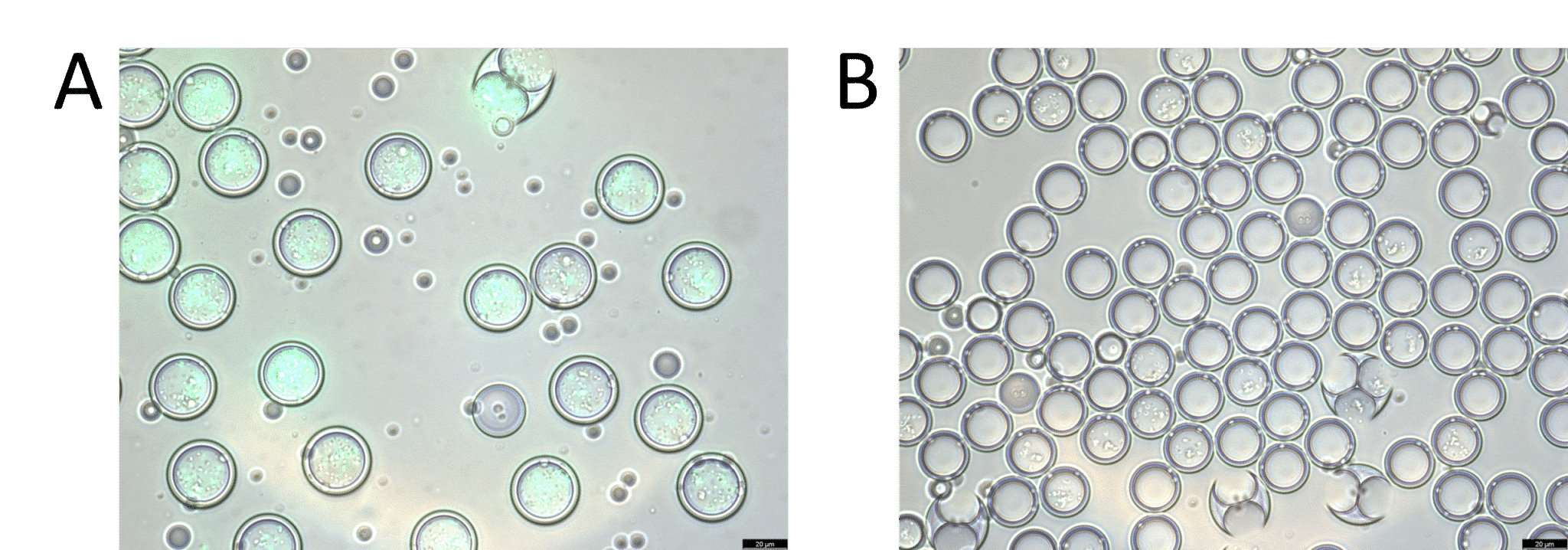
Droplet microfluidics represents an efficient approach for generating discrete compartments containing biological material such as fluorescent bacteria. In these workflows, water-in-oil or water-in-oil-in-water double emulsions are produced and subsequently processed by fluorescence-activated cell sorting (FACS) to isolate droplets based on their signal. [24,25]
These double emulsions act as confined microbioreactors, supporting controlled bacterial growth and localized biochemical activity within each droplet. The oil shell phase prevents fluorescence leakage between droplets, ensuring signal confinement in assays based on protein or enzyme secretion.
The coupling of droplet generation with FACS sorting enables high-throughput selection of functional droplets, providing a flexible platform for biochemical screening within microfluidic analytical techniques (Figures 14 and 15).
Conclusion and Perspectives
Microfluidic analytical techniques enable precise control of fluids at the microscale, where transport, mixing, and reactions can be tightly regulated within integrated platforms. Thanks to these advantages, analytical workflows become more efficient, with improved control over experimental conditions, reduced sample and reagent consumption, and streamlined multi-step processing within compact systems.
Future developments will increasingly rely on automation and machine learning to optimize experimental conditions, manage complex workflows, and interpret high-dimensional datasets in real time. These approaches will support more autonomous and adaptive analytical platforms, further extending the capabilities of microfluidic analytical techniques
Interested in integrating microfluidics into your analytical setup?
Contact us to discuss your application.
Related Solutions


Related Expertises
-
Microfluidics Case Studies A Microfluidic Approach for High-Throughput Raman Spectroscopy of Whole Blood Read more
-
Microfluidics Case Studies Automated Microfluidic Electrochemistry for Sustainable Cyclohexanol Oxidation Read more
-
Expert Reviews: Basics of Microfluidics Automation in Microfluidics: Real-Time Monitoring and Feedback Loops Read more
-
Microfluidics Case Studies Microfluidics-Interfaced Capillary Electrophoresis for Continuous Analysis of Nanoparticle–Bioentity Interactions Read more
-
Microfluidic Application Notes A quick and efficient double encapsulation method for FACS-based droplet sorting Read more
-
Expert Reviews: Basics of Microfluidics Choosing the Right Microfluidic Pressure Range Read more
-
Microfluidics White Papers An exploration of Microfluidic technology and fluid handling Read more
-
Microfluidic Application Notes Impedance Measurement of Microbeads Read more
-
Expert Reviews: Basics of Microfluidics The Importance of Flow Control Stability in Microfluidics Read more
-
Expert Reviews: Basics of Microfluidics Pump Responsiveness in microfluidics Read more
-
Expert Reviews: Basics of Microfluidics Flow Control Technologies: Comparison between peristaltic, syringe and pressure pumps for microfluidic applications Read more
References
[1] S. C. Terry et al, IEEE Transactions on Electron Devices, vol. 26, no. 12, pp. 1880-1886, Dec. 1979.
[2] Á. Ríos and M. Zougagh, ‘Modern qualitative analysis by miniaturized and microfluidic systems’, TrAC Trends in Analytical Chemistry, vol. 69, pp. 105–113, Jun. 2015, doi: 10.1016/j.trac.2015.04.003.
[3] A. Gómez‐Hens and J. M. Fernández‐Romero, ‘Microfluidic Systems in Analytical Chemistry’, in Encyclopedia of Analytical Chemistry, 1st edn, R. A. Meyers, Ed., Wiley, 2017, pp. 1–20. doi: 10.1002/9780470027318.a9591.
[4] L. Xia et al., ‘Recent Progress in Fast Sample Preparation Techniques’, Anal. Chem., vol. 92, no. 1, pp. 34–48, Jan. 2020, doi: 10.1021/acs.analchem.9b04735.
[5] A. M. Gonzalez-Suarez, A. Long, X. Huang, and A. Revzin, ‘A Compact Control System to Enable Automated Operation of Microfluidic Bioanalytical Assays’, Biosensors, vol. 12, no. 12, Dec. 2022, doi: 10.3390/bios12121160.
[6] B. E. Murray, L. I. Penabad, and R. T. Kennedy, ‘Advances in coupling droplet microfluidics to mass spectrometry’, Current Opinion in Biotechnology, vol. 82, p. 102962, Aug. 2023, doi: 10.1016/j.copbio.2023.102962.
[7] M.-H. Fortier, E. Bonneil, P. Goodley, and P. Thibault, ‘Integrated Microfluidic Device for Mass Spectrometry-Based Proteomics and Its Application to Biomarker Discovery Programs’, Anal. Chem., vol. 77, no. 6, pp. 1631–1640, Mar. 2005, doi: 10.1021/ac048506d.
[8] K.-C. Hsu, C.-F. Lee, W.-C. Tseng, Y.-Y. Chao, and Y.-L. Huang, ‘Selective and eco-friendly method for determination of mercury(II) ions in aqueous samples using an on-line AuNPs–PDMS composite microfluidic device/ICP-MS system’, Talanta, vol. 128, pp. 408–413, Oct. 2014, doi: 10.1016/j.talanta.2014.05.010.
[9] A. Lace and J. Cleary, ‘A Review of Microfluidic Detection Strategies for Heavy Metals in Water’, Chemosensors, vol. 9, no. 4, Mar. 2021, doi: 10.3390/chemosensors9040060.
[10] Y. Zhou et al., ‘Direct Infusion ICP-qMS of Lined-up Single-Cell Using an Oil-Free Passive Microfluidic System’, Anal. Chem., vol. 92, no. 7, pp. 5286–5293, Apr. 2020, doi: 10.1021/acs.analchem.9b05838.
[11] J. J. Heiland et al., ‘On-chip integration of organic synthesis and HPLC/MS analysis for monitoring stereoselective transformations at the micro-scale’, Lab Chip, vol. 17, no. 1, pp. 76–81, 2017, doi: 10.1039/C6LC01217E.
[12] I. M. Lazar, P. Trisiripisal, and H. A. Sarvaiya, ‘Microfluidic Liquid Chromatography System for Proteomic Applications and Biomarker Screening’, Anal. Chem., vol. 78, no. 15, pp. 5513–5524, Aug. 2006, doi: 10.1021/ac060434y.
[13] J. Xie, Y. Miao, J. Shih, Y.-C. Tai, and T. D. Lee, ‘Microfluidic Platform for Liquid Chromatography−Tandem Mass Spectrometry Analyses of Complex Peptide Mixtures’, Anal. Chem., vol. 77, no. 21, pp. 6947–6953, Nov. 2005, doi: 10.1021/ac0510888.
[14] V. M. Ugaz and J. L. Christensen, ‘Electrophoresis in Microfluidic Systems’, in Microfluidic Technologies for Miniaturized Analysis Systems, S. Hardt and F. Schönfeld, Eds, Boston, MA: Springer US, 2007, pp. 393–438. doi: 10.1007/978-0-387-68424-6_10.
[15] J. Zafar et al., ‘Microfluidics-interfaced capillary electrophoresis coupled with modular LED-based fluorescent detection: A new tool for continuous monitoring of the interaction between nanoparticles and bio-entities’, Sensors and Actuators B: Chemical, vol. 439, p. 137841, Sep. 2025, doi: 10.1016/j.snb.2025.137841.
[16] U. Bilitewski, M. Genrich, S. Kadow, and G. Mersal, ‘Biochemical analysis with microfluidic systems’, Anal Bioanal Chem, vol. 377, no. 3, pp. 556–569, Oct. 2003, doi: 10.1007/s00216-003-2179-4.
[17] W. Satoh, H. Hosono, H. Yokomaku, K. Morimoto, S. Upadhyay, and H. Suzuki, ‘Integrated Electrochemical Analysis System with Microfluidic and Sensing Functions’, Sensors, vol. 8, no. 2, pp. 1111–1127, Feb. 2008, doi: 10.3390/s8021111.
[18] X. Liang, M. Ouyang, N. P. Brandon, J. Xuan, and H. Wang, ‘Automated Microfluidics for Efficient Characterization of Cyclohexanol Electrooxidation for Sustainable Chemical Production’, JACS Au, vol. 5, no. 3, pp. 1340–1349, Mar. 2025, doi: 10.1021/jacsau.4c01207.
[19] T. Lederer, S. Clara, B. Jakoby, and W. Hilber, ‘Integration of impedance spectroscopy sensors in a digital microfluidic platform’, Microsyst Technol, vol. 18, no. 7, pp. 1163–1180, Aug. 2012, doi: 10.1007/s00542-012-1464-6.
[20] J. Ojarand, M. Min, and A. Koel, ‘Multichannel Electrical Impedance Spectroscopy Analyzer with Microfluidic Sensors’, Sensors, vol. 19, no. 8, Apr. 2019, doi: 10.3390/s19081891.
[21] G. L. Nelson et al., ‘Enabling Microscale Processing: Combined Raman and Absorbance Spectroscopy for Microfluidic On-Line Monitoring’, Anal. Chem., vol. 93, no. 3, pp. 1643–1651, Jan. 2021, doi: 10.1021/acs.analchem.0c04225.
[22] P. C. Ashok and K. Dholakia, ‘Microfluidic Raman Spectroscopy for Bio-chemical Sensing and Analysis’, in Optical Nano- and Microsystems for Bioanalytics, W. Fritzsche and J. Popp, Eds, Berlin, Heidelberg: Springer, 2012, pp. 247–268. doi: 10.1007/978-3-642-25498-7_9.
[23] F. Zorzi et al., ‘Flow cell for high throughput Raman spectroscopy of non-transparent solutions’, Lab Chip, vol. 25, no. 1, pp. 69–78, Dec. 2024, doi: 10.1039/D4LC00586D.
[24] L. Xia et al., ‘Recent Progress in Fast Sample Preparation Techniques’, Anal. Chem., vol. 92, no. 1, pp. 34–48, Jan. 2020, doi: 10.1021/acs.analchem.9b04735.
[25] K. K. Brower et al., ‘Double Emulsion Picoreactors for High-Throughput Single-Cell Encapsulation and Phenotyping via FACS’, Anal. Chem., vol. 92, no. 19, pp. 13262–13270, Oct. 2020, doi: 10.1021/acs.analchem.0c02499.