Webinar – Microfluidic Encapsulation for Biomass Valorization: From Self-Healing Biomaterials to Bacterial Pigment Protection
Microfluidic encapsulation offers a versatile way to add functionality to biomass-derived materials and protect sensitive bio-derived compounds.
In this webinar, discover how double-emulsion microfluidics is being applied to two complementary challenges in biomass valorization: self-healing biomaterials and bacterial pigment encapsulation. Through ongoing case studies, our experts will discuss how formulation, phase configuration, flow control and crosslinking strategies shape controlled core-shell structures.
These approaches rely on the Encapsulation platform (developed in collaboration with Secoya Technologies) combined with Fluigent’s precise pressure-based fluid handling.
📅 Date: September 30, 2026.
Speakers:
- Dr. Hassan El Itawi
Research Engineer – Chair of Biotechnology, Laboratoire de Génie des Procédés et Matériaux, CentraleSupélec, Université Paris-Saclay - Dr. Joseph Farah
Microfluidic Application Engineer – Fluigent - Dr. Adrien Dewandre
Co-Founder & Technology Lead – Secoya Technologies
What are Covered:
- Microfluidic encapsulation for self-healing biomaterials and bacterial pigment protection
Discover two complementary applications of microfluidic encapsulation for biomass valorization. In the first study, alginate-based carriers containing a self-healing formulation are generated using a controlled double-emulsion process and then incorporated into a film, with the objective of enabling localized repair after material damage. In the second study, an oil-in-water-in-oil (O/W/O) double emulsion is used to encapsulate a bacterial pigment in an oleic-acid core surrounded by a crosslinked alginate shell, with the aim of protecting the sensitive bio-derived active and retaining its functionality. Together, the two studies illustrate how microfluidic encapsulation can address different functional needs, from localized delivery to active protection.
With Dr. Hassan El Itawi. Research Engineer – Chair of Biotechnology, CentraleSupélec, Université Paris-Saclay
- Versatile microencapsulation with double-emulsion microfluidics
Discover the principles behind controlled core-shell droplet generation and how the same microfluidic approach can be adapted to different capsule materials and curing strategies, from alginate hydrogels to polymer-based systems using polymers such as PLGA, PEGDA or PMMA, depending on the targeted capsule architecture and application.
With Dr. Adrien Dewandre, Co-Founder & Technology Lead – Secoya Technologies
- Precise flow control for reproducible microcapsule generation
Learn how precise pressure and flow control contribute to stable double-emulsion formation and reproducible capsule production. Explore how controlling individual fluid phases and flow-rate ratios can influence capsule size, shell characteristics and payload while helping maintain process stability.
With Dr. Joseph Farah, Microfluidic Application Engineer – Fluigent
Curious to Find Out More About Our Encapsulation Solutions?
Encapsulation Platform for FACS
For cell-focused encapsulation workflows, the Encapsulation Platform for FACS is a complete RayDrop®-based system (device developed by Secoya Technologies) for efficient encapsulation of complex cells in highly monodisperse double-emulsion droplets compatible with downstream flow cytometry and FACS workflows. It combines precise pressure-based flow control, organized fluid handling and dedicated optics for robust, reproducible droplet production.
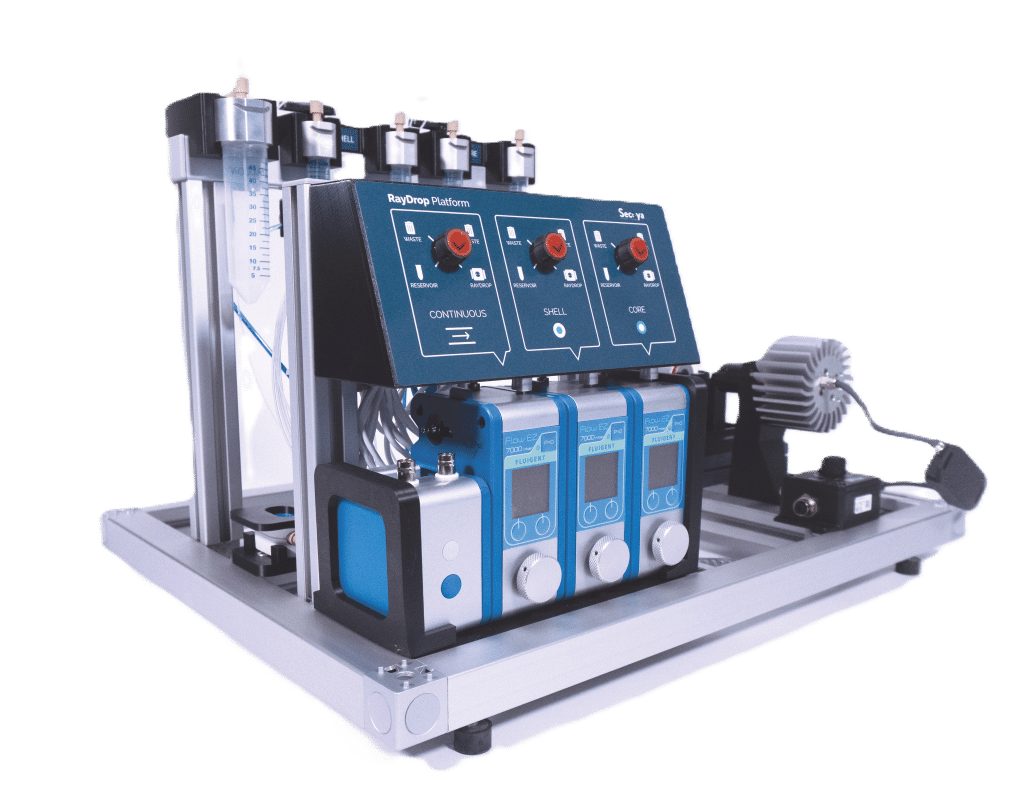
RayDrop® Double Emulsion Device
Generate controlled W/O/W and O/W/O double emulsions in a single coating-free device, with exchangeable configurations for tuning droplet and capsule dimensions.

Flow EZ™ Pressure-Based Flow Control
Use responsive, pulse-free pressure-based flow control to stabilize multiphase experiments and precisely tune the fluid conditions used for droplet and microcapsule generation.

Explore Related Resources:
Microfluidic Spheroid Encapsulation in Alginate Microbeads Using a Sacrificial Oil-Shell Method
Explore a separate alginate-encapsulation case study using controlled double emulsions and a sacrificial oil-shell approach for mammalian spheroid culture. It illustrates how controlled microfluidics can support reproducible alginate microbead generation.
Alginate Microbeads Production
Review a Fluigent application note on droplet-based microfluidic production of monodisperse alginate microbeads and the role of controlled droplet generation in improving size uniformity and reproducibility.