Understanding Two-Phase Flow with Microfluidic Porous Media Models
Investigating multiphase transport in porous materials is critical for applications such as enhanced oil recovery (EOR), carbon storage, and environmental engineering. Microfluidic porous media models provide a controlled platform to study fluid behavior and generate experimental data for model development. This case study highlights how Fluigent pressure-driven flow control systems and Micronit microfluidic chips support the investigation of two-phase flow mechanisms, from fundamental experimental studies to numerical model validation [1,2].
Solutions used in this case study


The Challenges of Studying Multiphase Transport in Porous Systems
Fluid transport through porous materials plays a key role in applications including enhanced oil recovery (EOR), carbon capture and storage (CCS), geothermal energy, and groundwater remediation. In these systems, fluid behavior is controlled by interactions between pore geometry, wettability, capillary forces, interfacial tension, and pressure gradients, which determine phase distribution and recovery efficiency. [3,4]
Studying these mechanisms remains challenging because they occur at small scales that are difficult to access with conventional techniques. Traditional approaches often provide bulk measurements but limited information about the local processes controlling fluid displacement, trapping, and redistribution. Understanding these relationships is therefore essential for improving predictive models and optimizing multiphase transport processes. [3,4]

What are microfluidic porous media models?
Microfluidic porous media models are transparent microfabricated chips containing engineered pore networks that replicate the structure of porous materials. They enable direct visualization and quantitative investigation of multiphase fluid flow under controlled laboratory conditions.
Why Use Microfluidic Porous Media Models?
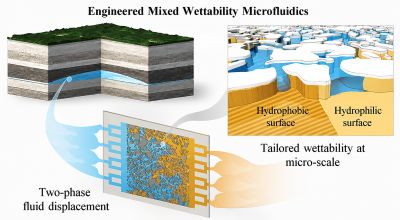
Microfluidic porous media models provide a controlled and transparent environment for studying fluid transport within engineered pore networks. By reproducing representative porous structures inside microfabricated chips, these platforms allow researchers to investigate fluid interactions under well-defined experimental conditions. [5,6]
Beyond porous media research, microfluidics offers several general advantages:
- Direct visualization of pore-scale phenomena – Observe interface movement, phase redistribution, and fluid trapping mechanisms in real time. [7,8]
- Precise experimental control – Independently control parameters such as pressure, flow rate, fluid composition, wettability, and interfacial properties to study their influence on multiphase flow behavior. [7,8]
- Low sample and reagent consumption – Perform experiments using very small fluid volumes, reducing material use and experimental costs. [6]
- Rapid experimentation – Shorter experimental times enable faster screening of fluids, formulations, and operating conditions. [6]
- High reproducibility – Engineered pore geometries and controlled operating conditions improve experimental consistency compared with many conventional porous media methods. [5,6]
- Parallel testing capabilities – Evaluate multiple conditions simultaneously within a single microfluidic workflow, increasing experimental throughput. [6]
Aim of the Case Study
This case study presents how Fluigent pressure-driven flow control systems and Micronit microfluidic chips were used to investigate two-phase flow in porous structures through two complementary research approaches.
The first study, developed at the Université de Bordeaux, demonstrates how microfluidic experiments can generate quantitative datasets for validating numerical models of multiphase transport. The second study, conducted at Texas Tech University, focuses on understanding how wettability and interfacial properties influence fluid recovery mechanisms in an oil-wet porous network.
Together, these studies illustrate how microfluidic approaches contribute both to the development of predictive simulation tools and to the fundamental understanding of fluid behavior in porous systems.
Materials and Methods: Building a Controlled Microfluidic Environment for EOR Research
The experimental workflow combined microfluidic chips, pressure-driven flow control, and microscopy imaging to study two-phase flow under controlled conditions (figure 3). The transparent networks enabled monitoring of fluid distribution and interface evolution, while image analysis provided quantitative information on phase saturation and displacement behavior.
Fluigent pressure-driven flow systems were used to regulate fluid injection and maintain stable experimental conditions. The Flow EZ (or MFCS™-EZ) pressure controller and Flow Units provided precise pressure control, real-time flow monitoring, and reproducible operation throughout the experiments.

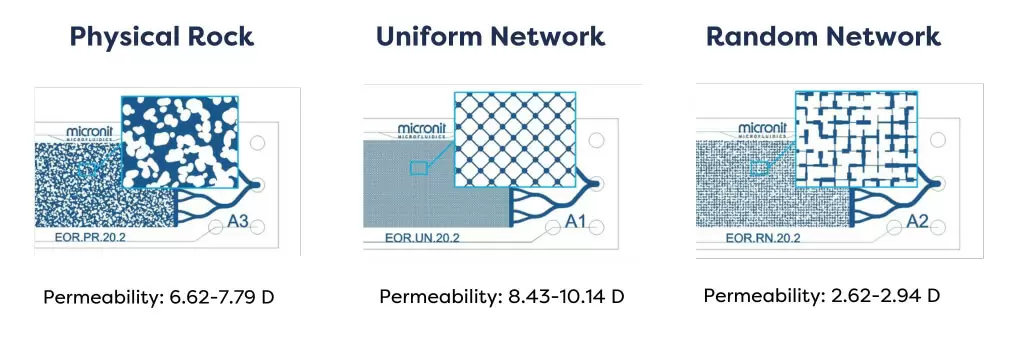
The microfluidic devices were fabricated by Micronit and designed to reproduce representative porous structures while preserving optical accessibility. Different chip architectures can be adapted to investigate various transport mechanisms in controlled environments as displayed on figure 4.
Proof of Concept 1 : Integrating Microfluidics and Numerical Modeling
Based on: Haohong Pi, Experimental-Numerical Analysis of Two-Phase Flow within Microfluidic Chip Porous Media Models (PhD Thesis), under the supervision of Dr. Abdelaziz Omari and Dr. Giuseppe Sciumè.
A PhD Thesis from the Institut de Mécanique et d’Ingénierie (I2M), Université de Bordeaux – UMR CNRS 5295
The research presented in this PhD thesis was conducted at the Institut de Mécanique et d’Ingénierie (I2M), a multidisciplinary CNRS laboratory at the Université de Bordeaux focused on mechanics, materials, and complex physical systems.
The institute combines experimental characterization, multiphysics modeling, and numerical simulation to investigate physical phenomena across multiple scales. Within this research environment, scientists develop approaches that connect experimental observations with computational methods to improve the understanding of complex transport processes. [1]
Experimental Approach and PhD Research Outcomes
Researchers investigated how experimental observations obtained from microfluidic porous media models could be integrated with numerical simulations to describe two-phase flow behavior. The microfluidic platform reproduced representative porous structures under controlled conditions (Figure 5), while Fluigent pressure-driven flow control systems (Flow EZTM) enabled accurate regulation of fluid injection.
The experiments generated quantitative datasets describing phase distribution, interface evolution, and displacement dynamics. These measurements were compared with numerical predictions to evaluate model performance and identify the parameters influencing multiphase transport.
The results demonstrated that microfluidic experiments can provide reliable reference data for computational approaches, improving the accuracy of simulations and supporting the development of predictive models for complex porous systems (Figure 6).


Proof of Concept 2: Investigating Wettability and Fluid Recovery Mechanisms
Based on: Tangirala, S. & Sheng, J. (2018), Effects of Invasion of Water with and without Surfactant on the Oil Production and Flowback through an Oil-Wet Matrix—A Microfluidic Chip Based Study.
A Paper from the Bob L. Herd Department of Petroleum Engineering, Texas Tech University
The research was conducted within the Bob L. Herd Department of Petroleum Engineering at Texas Tech University, which focuses on reservoir engineering, production optimization, and subsurface flow processes through experimental research and industry collaborations.
The study builds upon previous work performed with an initially water-wet microfluidic porous media model. By reproducing the same experimental protocol in an oil-wet microfluidic chip, the researchers aimed to better understand the mechanisms controlling oil displacement and recovery by investigating the influence of wettability and fluid properties within a controlled porous environment. [2,9]
Experimental Approach and Research Findings
Researchers used an oil-wet microfluidic porous media model (Figure 7) to study how wettability and interfacial properties affect fluid invasion and recovery. The objective was to reproduce key mechanisms involved in enhanced oil recovery, particularly those governing oil mobilization and residual trapping during water injection and flowback.
Aqueous phase injection and recovery were performed under controlled pressure conditions using Fluigent flow control technology. Microscopy imaging and saturation measurements enabled researchers to evaluate fluid distribution and quantify recovery behavior throughout the process (Figure 7).

The results showed that recovery efficiency decreased as invaded volume increased due to stronger capillary trapping and higher residual saturation. Changes in interfacial tension also influenced displacement behavior by modifying the balance between capillary and viscous forces (Figure 8).

These findings provided valuable insight into how wettability and fluid properties control multiphase transport and demonstrated the usefulness of microfluidic porous media models for studying enhanced oil recovery mechanisms.
Key Takeaways
✓ Microfluidic porous media models enable direct visualization of pore-scale multiphase flow.
✓ Pressure-driven flow control provides stable and reproducible experimental conditions.
✓ Microfluidic chips generate quantitative datasets for validating numerical simulations.
✓ Wettability and interfacial tension strongly influence displacement efficiency and residual trapping.
✓ These miniaturized platforms accelerate research in enhanced oil recovery, carbon storage, and environmental engineering.
Conclusion
These two studies demonstrate the versatility of microfluidic porous media models for investigating two-phase flow in porous materials. The Université de Bordeaux research showed how experimental data from microfluidic systems can strengthen numerical modeling approaches, while the Texas Tech University study revealed how wettability and interfacial properties influence fluid recovery and trapping mechanisms.
Together, these studies demonstrate how combining pressure-driven flow control with advanced microfluidic porous media models enables reproducible, quantitative investigation of multiphase transport. This integrated approach provides researchers with a powerful platform for developing predictive models and optimizing fluid recovery processes across energy and environmental applications.
Why Fluigent’s pressure-driven flow controller?
Fluigent pressure controllers are designed to meet the demands of microfluidic porous media research, where stable and reproducible flow conditions are essential. Their pressure-based approach enables precise control of injection conditions while minimizing flow fluctuations, allowing accurate investigation of pore-scale displacement, capillary trapping, and wettability effects. Compatible with a variety of microfluidic chip designs, Fluigent systems help researchers perform reliable experiments that support both fundamental studies and the validation of numerical models for enhanced oil recovery and related applications.

Flow EZ™
Explore more- Expert Reviews: Basics of Microfluidics
Flow Control Technologies: Comparison between peristaltic, syringe and pressure pumps for microfluidic applications
Explore more - Microfluidics White Papers
An exploration of Microfluidic technology and fluid handling
Explore more 
Webinar- Flow Control in Microfluidics
Explore more

Testimonial

“Fluigent has played a crucial role in helping us setup and achieve our microfluidic experiments at Texas Tech University’s Petroleum engineering research laboratory. Since we were assembling this unique lab-on-a-chip apparatus for the first time in the department, consulting with Fluigent’s USA team helped us effectively collaborate with them and Micronit, our supplier of microfluidic chips and chip holders. With Fluigent’s valuable support, we published three microfluidics-related scientific papers from our research in 2018-19 and also presented the work at SPWLA’s Boston Chapter during a workshop on Porous media: Structure, Flow and Dynamics in November 2019. The experimental setup and efforts were well received by the peers from Schlumberger-Doll Research Center and Aramco Research Center at Boston.”
Srikanth Tangirala, Ph.D, Bob L. Herd Department of Petroleum Engineering, Texas Tech University

Expertise & Resources
-
Expert Reviews: Basics of Microfluidics Microfluidics and Analytical Techniques: Benefits, Applications and Integration Strategies Read more
-
Expert Reviews: Basics of Microfluidics Automation in Microfluidics: Real-Time Monitoring and Feedback Loops Read more
-
Expert Reviews: Basics of Microfluidics Microfluidic Flow Sensing Technologies, A Review Read more
-
Microfluidics White Papers An exploration of Microfluidic technology and fluid handling Read more
-
Expert Reviews: Basics of Microfluidics Flow Control Technologies: Comparison between peristaltic, syringe and pressure pumps for microfluidic applications Read more
-
Expert Reviews: Basics of Microfluidics Microfluidics overview: History and Definition Read more
Bibliography
[1] H. Pi, ‘Experimental-numerical analysis of two-phase flow within microfluidic chip porous medium models’.
[2] S. Tangirala and J. Sheng, ‘Effects of Invasion of Water with and without Surfactant on the Oil Production and Flowback through an Oil Wet Matrix—A Microfluidic Chip Based Study’, OJOGas, vol. 03, no. 04, pp. 278–292, 2018, doi: 10.4236/ojogas.2018.34024.
[3] K. Singh, M. Jung, M. Brinkmann, and R. Seemann, ‘Capillary-Dominated Fluid Displacement in Porous Media’, Annual Review of Fluid Mechanics, vol. 51, no. Volume 51, 2019, pp. 429–449, Jan. 2019, doi: 10.1146/annurev-fluid-010518-040342.
[4] D. Podoprigora, R. Byazrov, and J. Sytnik, ‘The Comprehensive Overview of Large-Volume Surfactant Slugs Injection for Enhancing Oil Recovery: Status and the Outlook’, Energies, vol. 15, no. 21, Nov. 2022, doi: 10.3390/en15218300.
[5] J. Avendaño, N. Lima, A. Quevedo, and M. Carvalho, ‘Effect of Surface Wettability on Immiscible Displacement in a Microfluidic Porous Media’, Energies, vol. 12, no. 4, Feb. 2019, doi: 10.3390/en12040664.
[6] S. Gogoi and S. B. Gogoi, ‘Review on microfluidic studies for EOR application’, J Petrol Explor Prod Technol, vol. 9, no. 3, pp. 2263–2277, Sep. 2019, doi: 10.1007/s13202-019-0610-4.
[7] A. AlOmier, M. Hoecherl, D. Cha, S. Ayirala, A. A. Yousef, and H. Hoteit, ‘Experimental Investigation of the Impact of Mixed Wettability on Pore-Scale Fluid Displacement: A Microfluidic Study’, ACS Appl. Mater. Interfaces, vol. 16, no. 50, pp. 69165–69179, Dec. 2024, doi: 10.1021/acsami.4c13018.
[8] ‘Wettability control on multiphase flow in patterned microfluidics | PNAS’. Accessed: Jun. 23, 2026. [Online]. Available: https://www.pnas.org/doi/full/10.1073/pnas.1603387113
[9] S. Tangirala and J. J. Sheng, ‘Investigation of oil production and flowback in hydraulically-fractured water-wet formations using the Lab-on-a-Chip method’, Fuel, vol. 254, p. 115543, Oct. 2019, doi: 10.1016/j.fuel.2019.05.126.